Unknown's avatar

Feature Artist – A Surprise Guest

Good Morning,

One of my dearest friends is also an amazing and extremely talented artist.  Not only does he sculpt incredibly detailed and fabulous monsters, but he has several movie credits to his name as well, including CoralineParanorman, and the Cult Classic, The Toxic Avenger.

Some of you have seen  his work, and probably not even realized it, as well as my personal collection of his art work that I post on occasion.

Raphael Cordero or Ralph, is the owner and operator of Studio RGC and the creator of Ralph’s TMS Wax.  You can find and buy all of wonderful creations at the link above or by following the links below.

Let’s have a look at some of Ralph’s amazing work.  

Twisted Little Things

Hal I Toesis – $33.00

Skull and Bones Incense Burner – $42.00

Zombie Heads (Sold Individually) – $13.00 ea.

One of my favorites and available on Etsy is:

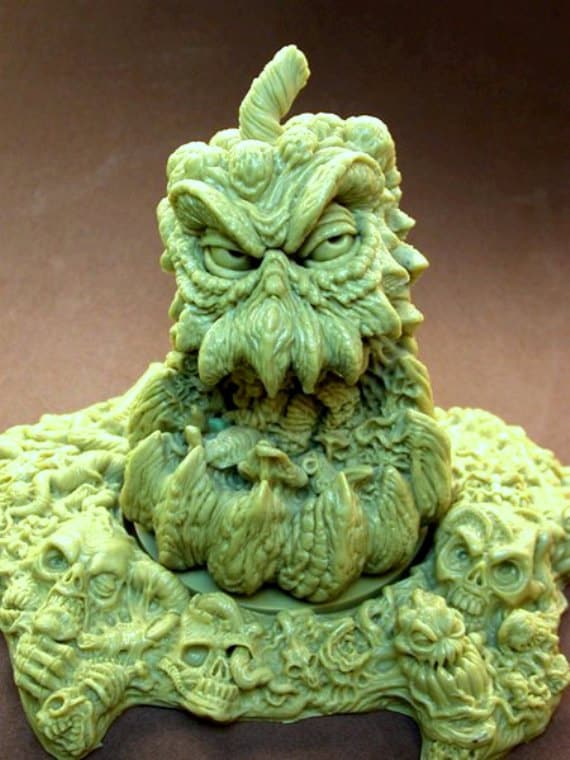
Squash the Bog Monster
Squash the Bog Monster Squash the Bog Monster Squash the Bog Monster

Squash comes in a tomato green or translucent cream – please specify which you prefer.
6.75 inches tall by 6.75 deep and 8.5 inches wide. Cast in solid resin. Weighs approx 2.5 lbs
Item shipped to areas other than the U.S., Canada, or Mexico, please contact for quote. 

You may Ralph and his wonderful wax at any of the links provided.  You may also do a little homework on this creative mind by checking out the IMDB page.

Thank you for stopping by and having a look.  In hope that this has inspired you to have a gander at the other things he has on offer.  We encourage to buy handmade!

The Alchemists Vessel would like to wish you a pleasant day.  

Unknown's avatar

Filigree Leaf Motif Sterling Silver Ring on Handmade Artists’ Shop

Filigree Leaf Motif Sterling Silver Ring on Handmade Artists’ Shop.

Filigree Leaf Motif Sterling Silver Ring on Handmade Artists' Shop


Unknown's avatar

Links, Promotions and a Diversion or Two

Happy Friday,

The weekend is here and there is a lot going on in Boise.  As usual I will be at the work bench working on items as well as visiting some of the local events.  

EVENTS:

Get your Halloween on this weekend!  The Witches Market is this Sunday, October ,14, 2012.  Hosted by my friend Shelly Moody, and held in:
Bella’s Grove, 2210 S. Broadway, Boise, ID.  
10:00 a.m. to 4:00 p.m.

Shelly says:

 This will be our second Annual Witches Market. We will have vendors and goodies and all kinds of great stuff. Join us in merrymaking and frivolity and take the opportunity to support your community and get a jump on your Yule shopping! We will have vendors selling custom leather work, incense, jewelry, terrariums, and other odd bits and pieces. We will have Tarot Readers, and a palm reader as well

 Saturday, October 13th, 2012 Fashion Victim’s Ball
Dressing badly is the point of this offbeat and beneficial fund raiser for Camp River Run and All About Kids.  There will be, Music by local bands, Silent Auctions, 21 and over, $15.00 at the door.

 Fashion Victim’s Ball | Mardis’ Gras Ballroom | Boise Events

PROMOTIONS

 Many of you have seen those cute little grotesque sculptures that I collect now and again.  Instead of going to Etsy to get them you can now get them direct from the Artist, my friend, Raphael Cordero of Studio RGC.  I love these Twisted Little Things and there are more, a veritable Zombie Smorgasbord!  Highly detailed, original and unique cast in solid resin, you can even paint them.  Collect ’em all!

My favorite Twisted Little Thing

“Hal I Toesis”

 
 Pumpkin Sculptures anyone?  Check out Ray Villafane’s amazing Artwork.  Villafane Studios – Pumpkin Carving

Here is a fun little romp through some amazing pumpkin art for Halloween.  Geek-o-Lanterns

I think that’s all the fun for today!  

Thank you for stopping in and having a look.

The Alchemists Vessel would like to wish you a pleasant weekend.


Unknown's avatar

CUTTLEBONE CASTING PART III – Re-Blog Complete With Pictures


Monday!  

I hope every one is still enjoying their Holiday Weekend.

The first time this was posted I was experiences some technical difficulties, and after consulting an iMac savvy friend,  I have picture upload once again!

If you would like to follow along or have just started to read here, may I suggest reading (or taking a brief scan)
Cuttlebone Casting Part I – Materials and Model Making
Cuttlebone Casting Part II – Model and Mold Preparation

PART III Casting the project.
TOOLS:
Tin Alloy Soldering Wire (4 tubes, 20 feet)
Mini-Torch
Prepared Cuttlebone Mold
Vice Grip or Prop
Safety Gear
Goggles / Glasses
Gloves, leather shoe strings (something to wrap the spoon handle) 

NOTE:  The sample casting shown used 2 to 2-1/2 tubes of Tin Alloy Solder, your project may require more or less depending on size of the model and depth of the impression.

SAFETY FIRST!  This lesson consists of playing with fire, and I mean literally.  Temperatures reach 400 degrees and possibly higher!  Be aware of your surroundings and your work area!  Remove any and all distractions and make sure you have an uninterrupted block of time in which to work.  Although this portion of the process is fairly quick, you must pay attention to what you are doing!  Turn off your cell-phone, send the kids outside to play, give the hubby a “Honey-Do” list and feed the dog; you must be and remain focused!

Last time we made a wax model and a mold from simple and easy to obtain materials.  Today we are going to complete the process and show the steps for actually casting the piece.  The step-by-step process for creating a mold may be read in CuttleboneCasting Part II – Model and Mold Preparation.
The cuttlebone mold is now ready for molten metal.  Cuttlebones are naturally heat resistant.  This means that they can withstand high heat without distorting in shape, and make wonderful molds for just that reason.  They are also a completely natural tool with no added chemicals and won’t harm the environment.  Eco-friendly jewelry creation, that’s a plus! 

PRE-CASTING PREPARATIONS:

Prepare your work area.  Make sure it is free of anything flammable and fluttery that might catch fire or drift into the molten metal.  Place your mold in the Vice Grip or other object you have chosen to keep it steady and upright.  Get your spoon (or whatever you’re going to use to melt the metal in), torch, and tin alloy lined up, ready to go, and easily accessed! 
**TIP:  Trim the tin alloy coils into smaller pieces; this will make melting and adding it to the already melted material much easier.
NOTE:  Unlike other casting processes that use high-speed centrifuges or kiln (oven) burn out cycles (Lost Wax Casting) to distribute the material to the mold, all that is working here is gravity!  Pouring the molten metal into the mold is like filling a glass with sand, the material will be layered as you pour it into the mold.

Here I have the cuttlebone mold in a prop to keep it upright and steady as material is poured.  Closed with Rubber bands and waiting for metal to be melted and poured.

MELT THE METAL / FILL THE MOLD:
*The Spoon will reach temperatures of up to 400 degrees (the melting point of the tin alloy is 374-degrees), USE PROTECTIVE MEASURES!  Leather gloves or wrap the end with leather shoestrings to keep the heat away form your hands and fingers.

Begin by adding a small amount of the Tin Alloy to the spoon.  Cut bits off the coil first to make this easier.  Let it sit in the bowl of the spoon.  Do not try to melt the whole coil all at once.   Using a mini-torch, hold the spoon just above the flame and melt the metal in the spoon, continue to add bits of metal until the spoon is full.

The flame has not been turned on for these pictures, that would be hazardous to my heath and the I’d burn the house down.  These are to show the spoon’s position it should be held up and away from the nozzle of your torch and the flame allowed to heat the bowl of the spoon from underneath.
Because the soldering material is a tin / rosin core alloy, you will see the rosin left behind in the spoon, and some smoke may rise as the rosin burns away.  That is the brown discoloration on the spoon and mold.  Rosin comes from trees and is a brittle solid form of resin, it is used as a flux in some soldering materials to help the metal melt and flow at an even rate.  This discoloration will not appear on your piece, this is left behind after the melting process. 
NOTE:  The molten metal will pool in the bowl of the spoon.  Adding pieces of material closer to the pool will help it to melt and incorporate into the ever growing puddle of metal.  It will slide around in the spoon hold the spoon steady while melting is in process. 
Coil melting into pool of molten metal
Melted puddle of metal.
Continue to add pieces of the Tin Alloy until the spoon is full, or until you think there is enough metal to fill the mold.
Carefully pour the contents of the spoon into the Sprue Hole and down the Sprue Channel.
Repeat the melting and pouring process until your mold is full, if necessary.  You will have to look through the Sprue Hole and do a little guessing here to be sure that the material has filled the mold (impression) completely.  You DO NOT want to fill the Vent Gates or Sprue Channel, just enough metal to fill the mold of the Cross.

Instant Gratification…. Well almost.  After the mold is full, wait a full ten to fifteen minutes for the metal to solidify and harden.  The mold will also be cooling down during this time, making it a little easier to handle.

Here you can see the burn mark on the top of mold, where the spoon touched the surface of the cuttlebone.  The cuttlebone sits in its prop cooling down while the metal is solidifying.

Once time is up, carefully remove the binding from the outside of the mold, unwind the wire, slip off the rubber bands (whatever was used) gently, keeping the mold closed as you do this.  If you used Duct Tape (and I told you not to) you will have to cut it away with a razor-blade where the two halves of the mold meet and split the mold open like a book.

 
Well looky there!  You have a metal pendant!  TAH-DAH!
 
The tin alloy is soft enough that you can drill a hole in the top of the cross using a drill bit and your hand for a bail to be glued (soldered) into place.
FINAL FINISHING:
 
Using Sandpaper and a file, will “clean” up the casting.  Some of the metal over flowed the mold impression and will have to be removed.  You can also see the natrual pattern of the cuttlebone has left surface impressions as well.  These may be left as is or sanded, filed and polished.
 
Cleaned, sanded and filed casting. The bone’s pattern has created a line in the  surface of the cross
 
To complete my pendant, I will seat the simulated Garnet into the center hole of the Cross.  Using a brass rod that I have ground to a 45-deegree angle at one end, I will finish the pilot hole for the gem and seat it in to place.  Using a craft knife or razor blade, I will then create PRONGS by scraping some of the metal from the Cross up and over the gemstone in four evenly spaced places around the stone’s setting.
Complete Cross before scrapping prongs and final polishing.
Although this will leave dents in the exterior of the Cross surface, it will help secure the stone into place.

 After the gemstone setting is complete I will use a Polishing Cloth (these have chemicals embedded in the material) and gently rub the surface of the piece, polishing it and giving a little shine.

It is now ready to be displayed or worn on chain or lanyard.

Thank you so much for stopping by and having a look, and if you have followed the whole series, thank you for sticking with us.  We hope you have enjoyed this brief look in to one of the many casting processes available and used for jewelry-making.

The Alchemists Vessel would  like to wish you a pleasant day.

**Want something like this, but don’t want to do it yourself?  Custom work is available.  All custom molding projects begin at $50.00 this includes Design materials and Mock Up of your custom piece before casting.  Precious Metals are available for this process.


Unknown's avatar

Cuttlebone Casting Part III – Casting The Piece


Hello,

Please note, due to technical difficulties some of the photos for this tutorial are not shown (photo error), this post will be updated once the photo upload decides to cooperate.  We apologize for any inconvenience this may cause and are working to rectify the situation.

This is the final stage in casting a piece of jewelry with a cuttlebone mold.  If you have not been following along or have just discovered this series, please refer to the previous posts for an overview.
 

Cuttlebone Casting – Part II Model and Mold Preparation

PART III Casting the project.
TOOLS:
Tin Alloy Soldering Wire (4 tubes, 20 feet)
Mini-Torch
Prepared Cuttlebone Mold
Vice Grip or Prop
Safety Gear
Goggles / Glasses
Gloves, leather shoe strings (something to wrap the spoon handle) 

NOTE:  The sample casting shown used 2 to 2-1/2 tubes of Tin Alloy Solder, your project may require more or less depending on size of the model and depth of the impression.

SAFETY FIRST!  This lesson consists of playing with fire, and I mean literally.  Temperatures reach 400 degrees and possibly higher!  Be aware of your surroundings and your work area!  Remove any and all distractions and make sure you have an uninterrupted block of time in which to work.  Although this portion of the process is fairly quick, you must pay attention to what you are doing!  Turn off your cell-phone, send the kids outside to play, give the hubby a “Honey-Do” list and feed the dog; you must be and remain focused!
Last time we made a wax model and a mold from simple and easy to obtain materials.  Today we are going to complete the process and show the steps for actually casting the piece.  The step-by-step process for creating a mold may be read in CuttleboneCasting Part II – Model and Mold Preparation.
The cuttlebone mold is now ready for molten metal.  Cuttlebones are naturally heat resistant.  This means that they can withstand high heat without distorting in shape, and make wonderful molds for just that reason.  They are also a completely natural tool with no added chemicals and won’t harm the environment.  Eco-friendly jewelry creation, that’s a plus!
PRE-CASTING PREPARATIONS:
Prepare your work area.  Make sure it is free of anything flammable and fluttery that might catch fire or drift into the molten metal.  Place your mold in the Vice Grip or other object you have chosen to keep it steady and upright.  Get your spoon (or whatever you’re going to use to melt the metal in), torch, and tin alloy lined up, ready to go, and easily accessed! 
**TIP:  Trim the tin alloy coils into smaller pieces; this will make melting and adding it to the already melted material much easier.
(Photo error)
NOTE:  Unlike other casting processes that use high-speed centrifuges or kiln (oven) burn out cycles (Lost Wax Casting) to distribute the material to the mold, all that is working here is gravity!  Pouring the molten metal into the mold is like filling a glass with sand, the material will be layered as you pour it into the mold.

Here I have the cuttlebone mold in a prop to keep it upright and steady as material is poured.  Closed with Rubber bands and waiting for metal to be melted and poured.

MELT THE METAL / FILL THE MOLD:
*The Spoon will reach temperatures of up to 400 degrees (the melting point of the tin alloy is 374-degrees), USE PROTECTIVE MEASURES!  Leather gloves or wrap the end with leather shoestrings to keep the heat away form your hands and fingers.
Begin by adding a small amount of the Tin Alloy to the spoon.  Cut bits off the coil first to make this easier.  Let it sit in the bowl of the spoon.  Do not try to melt the whole coil all at once.   Using a mini-torch, hold the spoon just above the flame and melt the metal in the spoon, continue to add bits of metal until the spoon is full.
The flame has not been turned on for these pictures, that would be hazardous to my heath and the I’d burn the house down.  These are to show the spoon’s position it should be held up and away from the nozzle of your torch and the flame allowed to heat the bowl of the spoon from underneath.
Because the soldering material is a tin / rosin core alloy, you will see the rosin left behind in the spoon.  That is the brown discoloration you see.  Rosin comes from trees and is a brittle solid form of resin, it is used as a flux in some soldering materials to help the metal melt and flow at an even rate.  This discoloration will not appear on your piece, this is left behind after the melting process.
NOTE:  The molten metal will pool in the bowl of the spoon.  Adding pieces of material closer to the pool will help it to melt and incorporate into the ever growing puddle of metal.  It will slide around in the spoon hold the spoon steady while melting is in process. 
(Photo error)
Continue to add pieces of the Tin Alloy until the spoon is full.
Carefully pour the contents of the spoon into the Sprue Hole and down the Sprue Channel.
Repeat the melting and pouring process until your mold is full, you will have to look through the Sprue Hole and do a little guessing here to be sure that the material has filled the mold (impression) completely.  You DO NOT want to fill the Vent Gates or Sprue Channel, just enough metal to fill the mold of the Cross.
Instant Gratification…. Well almost.  After the mold is full, wait a full ten to fifteen minutes for the metal to solidify and harden.  The mold will also be cooling down during this time, making it a little easier to handle.
Here you can see the burn mark on the top of mold, where the spoon touched the surface of the cuttlebone.  Here the cuttlebone sits in its prop cooling down while the metal is solidifying.
Once time is up, carefully remove the binding from the outside of the mold, unwind the wire, slip off the rubber bands (whatever was used) gently, keeping the mold closed as you do this.  If you used Duct Tape (and I told you not to) you will have to cut it away with a razor-blade where the two halves of the mold meet and split the mold open like a book.
(Photo error)
Well looky there!  You have a metal pendant!  TAH-DAH!
(Photo error)
The tin alloy is soft enough that you can drill a hole in the top of the cross using a drill bit and your hand for a bail to be glued (soldered) into place.
FINAL FINISHING:
To complete my pendant, I will seat the simulated Garnet into the center hole of the Cross.  Using a brass rod that I have ground to a 45-deegree angle at one end, I will finish the pilot hole for the gem and seat it in to place.  Using a craft knife or razor blade, I will then create PRONGS by scraping some of the metal from the Cross up and over the gemstone in four evenly spaced places around the stone’s setting.
Although this will leave dents in the exterior of the Cross surface, it will help secure the stone into place.
After the gemstone setting is complete I will use a Polishing Cloth (these have chemicals embedded in the material) and gently rub the surface of the piece, polishing it and giving a little shine.
It is now ready to be displayed or worn on chain or lanyard.
Thank you so much for stopping by and having a look, and if you have followed the whole series, thank you for sticking with us.  We hope you have enjoyed this brief look in to one of the many casting processes available and used for jewelry-making.
The Alchemists Vessel would  like to wish you a pleasant day.
**Want something like this, but don’t want to do it yourself?  Custom work is available.  All custom molding projects begin at $50.00 this includes Design materials and Mock Up of your custom piece before casting in the material of your choice!  Precious Metals are available for this process. Please feel free to return for the updated post, once I get the photos to cooperate! 


Unknown's avatar

Cuttlebone Casting Part II – Model and Mold Preparation

Good Morning,
 
Wednesday’s are devoted to what’s happening in the studio here at The Alchemists Vessel, and this morning is Part II of the three part series, Cuttlebone Casting.
 
Monday we discussed materials and the very basics of beginning to model and mold the pendant.  Today we are going to continue the project with making the model and creating the mold itself.
 
If you would like to follow along, I recommend a quick review of Monday’s post, Cuttlebone Casting Part I – Materials and Model Making.
TOOLS:
Pencil
Paper
Pin or Sharp Pointy Object
Modeling (Jeweler’s) Wax
Flat File
Jeweler’s Saw
Lighter Fluid
Soft Cloth
Brass Rods
Unsharpened Pencil

Prepared Cuttlebone halves

Last time the design of the piece was decided upon, sketched and cut out.  The sample project shown throughout the instruction will be  simple Cross shape.

This is about 1-1/2″ tall x 1-1/4″ wide.  Sketched in pencil (then traced with ink for a clearer photo), cut out of the paper, this will be the Paper Template from which to trace or “scribe” the design on to the wax block.

PREPARE THE MODEL

Cut out and place your Paper Template on top of the modeling wax and with a pin or other sharp object draw or “scribe” your design into the wax.  Trace the template.  Below is a T-pin, which I use to scribe the design in to the wax.
Note: You can see that the template is a little too long for the wax, you may adjust your design to fit with in the wax area before your trace the design.
Next with a Jeweler’s Saw and a Spiral saw blade (these cut modeling wax best, and straight blades work just fine, too) cut out your model.

Here is the beginning of the wax model.  Using a straight saw blade the block has been cut along the scribed lines in the wax.  Once completely cut out the model will be ready for final preparations.

Once your model is cut out, use a wax file to smooth and true the edges up, keeping them straight and even.  They make specific files for wax, if one is not available a flat jewelers / craft file will work as well.
Using a tiny bit of lighter fluid and a soft cloth, smooth out the surface, corners, and sides of the model.  This will remove any imperfections, nicks and scratches, and smooth the surface for a better impression.  Remember every imperfection will transfer to the finished product.  Be careful, over working the wax will distort or destroy any detail you may have carved into the model.
I have drilled tiny pilot holes in my design, the center hole will house the gemstone, and the others are to keep the design consistent.

NOTE:  I failed to take a picture prior to completing the next steps.  What you see here, is the final model, after it has been pressed into the cuttlebone halves.  The white material is dust from the bone.   Also, I dropped it, as I mentioned the wax is very brittle and I managed to break the arm of the Cross on one side.  However this happened after creating the mold impression!

Whew!  Almost there!
MAKE THAT MOLD
Now the fun starts!  Using one side of your cuttlebone, press your model into the flat surface of the bone.  The bone is soft, use gentle even pressure.  Next place the other half of the cuttlebone on top of the wax model and other half of the bone-mold and press the two sides together.  GENTLY!  If you press too hard the cuttlebone will break and another one will have to be prepared before continuing.  The wax model is now embedded in the cuttlebone.  It does take some pressure, and you can hear the model sinking into the surface of the cuttlebone.  The halves do need to touch, but press the wax into them enough for a well-defined impression.
With a pencil, mark several places on the outside of the bone so you can align the halves later.  This is important, the sides of the mold must match up for the inside to cast properly.
Remove the model.  The impression will be left behind.  This model may be used again to make another mold.
 
Here you can see the impression the wax model has made in the bone, along with the natural striated patterns of the bone itself, they are distorted by the the impression of the cross.  (The other side of the cuttlebone looks just like this).

If desired, very, very carefully sand the impression for better definition.  Do not overwork the area or you can distort the impression.

ADD SPRUE CHANNELS AND VENT GATES
Choosing one side of the mold, lay it flat and using the end of a pencil (not sharpened) create a SPRUE CHANNEL by gently pressing the pencil into the bone, just above and at the edge of the impression.  What’s a sprue channel?  It is a channel that allows the material you’re pouring to enter the mold for casting.  Make sure that this just touches the edge or of your model impression, but not so much to distort your design.  (Simon didn’t say to remove the pencil).
Next using brass rods or something with a smaller diameter than the pencil create VENT GATES.  What’s a vent gate?  It is a channel that will allow air to escape the mold during the casting process.  Just like you did with the pencil, using two (2) Brass rods (or tool) lay them just at the end and edge of the arms of the Cross.  These should also just touch the edge of the impression.  With the pencil and then the rods in place, place the second half of your mold over the pencil and rods and press down, keeping in mind to align the pencil marks on the outside of the cuttlebone.  The channels must be created in both sides of the mold.  Take the halves apart, remove the pencil and rods.
Are you still with me?  Still want to make a piece of jewelry?   Alrighty then!  Here we go!
Now match up the halves with the lines you made on the outside.  Find the Sprue Channel. Very carefully mark the top of the mold (both sides), on either side of the Sprue Channel.  This is where you will cut the SPRUE HOLE.  What’s a sprue hole?  It is a larger opening in the mold, which allows you to pour material into the Sprue Channel and into the mold.  This makes it easier to pour the material from whatever you have melted your material in, into the mold itself.  If you try to aim for the Sprue Channel you will wind up with material on the outside of the mold and possibly severe burns.  Molten Metal is HOT HOT HOT!  This project only gets up to about 400 degrees, but that can still do some serious damage!  Be careful.
Here you can see the Vent Gates, Sprue Hole, Sprue Channel, and the pencil marks I made on the outside of the bone to align the pieces.
Now align the Mold again.  Using Mold Wire, Rubber bands, or other type of binding (I do not recommend Duct Tape or other adhesive strips or bindings), match up the halves and secure (close) the mold.
The photo above is the closed mold, with Rubber band binding.
You just made a mold.  COOL!

WHEW!

Set the mold aside, some place safe and dry.

The preparations are now done and the mold is ready to begin casting the piece.

Take a break, have a little sit down and enjoy some tea, coffee, a beverage, or snack of your choice!  You’ve earned it!

Next time.  Part III – Casting the piece. 

Thank you for stopping by and having a look.

The Alchemists Vessel would like to wish you a pleasant Wednesday.

Unknown's avatar

Cuttlebone Casting Part I – Materials and Model Making


Good Morning,
 
Monday is here bright, and still smoky from all the fires in the surrounding states.
 
Today and throughout the next couple of  days and weeks we will take a look at a method of casting a piece of jewelry from easily obtained materials.  No special equipment is required for this project, although you will need a heat source that can reach temperatures of up to and over 400-degrees.
The materials are easily obtained and there is quite a bit of preparation required.  Part I includes materials, and preparing the mold for the model.  We will also discuss designing and making the model briefly, and it will be covered in full in Part II.  I emphasize DO NOT TRY THIS AT HOME!  I did, but that doesn’t mean you should!
Let’s begin.
For this project the following materials and tools are required:
A Cuttlebone
Jeweler’s Saw
Jeweler’s Modeling Wax (Green)
Mini-Torch (Butane)
Gloves (Leather workman’s gloves)
Pencil
Brass Rods
320 to 600 Grit Sandpaper
File (Small Rasp / Crafting File)
Tin Soldering Material (Lead-Free Tin Alloy) 4 tubes (20 feet)
Paper
Pin
Small Vice Grip / Prop (Optional, but really should find something)
3mm Simulated Garnet Faceted “gemstone”. (Optional)
Rubber bands  or Molding Wire
Gloves or Leather Shoe Strings (Leather workman’s glove is best)
Safety Glasses or Goggles
Painter’s Mask  (Respirator – Paper Surgical Mask)
Lighter Fluid
Soft Cloth or Paper towel.
This is a cuttlebone.  It comes from a cuttlefish, very much like a squid or octopus.  You can find these at your local Pet Stores and stores that carry pet supplies.  They are inexpensive, and a little difficult to work with as they are very brittle and break very easily.  (These provide essential nutrients for your feathered pal!)  They do come in different sizes and the bigger the better.
Cuttlebones are naturally heat resistant.  This means that they can withstand high heat without distorting in shape, and make wonderful molds for just that reason.  They are also a completely natural tool with no added chemicals and won’t harm the environment.  Eco-friendly jewelry creation, that’s a plus!
PREPARE THE CUTTLEBONE:
First, remove the metal bar that allows you to attach it to a cage.  Using a jewelers saw cut the cuttlebone in half. 
 
 
Using 320 to 600 grit Sandpaper, sand the flat sides of the halves as smooth as possible.  Remember any imperfection will transfer to the final piece.  Since there are natural patterns in the bone itself, it is almost impossible to get a perfectly smooth surface.  This is a great process for rustic or primitive-look pieces that you wish to create.  When sanding it is a good idea to do so on a piece of paper or over an area that can be cleaned easily.  The bone dust is very fine and will get into everything.  You may wish to wear a painters mask when sanding the cuttlebone halves.

These are very small and get smaller with sawing and sanding.  Choose two sides that you have sanded and match them up, by laying one half on top of the other. This looks pretty good.  Set these aside someplace safe.  Do not drop them, or you will have to begin again.  These are very brittle and break easily.  Gentle pressure is all that is required.  Remember you’re making jewelry not mining for ore!  Death Grips will damage and in some cases destroy your mold and all your hard work.

You can see the natural pattern of the bone in the cross-cut section.  The flat side of the bone has been sanded flat, and halves placed on on top of the other, the “join” is smooth and the pieces sit evenly.  
 
The model you design will fit within the flat area of the bone, and should not extend past the married surfaces.
The cuttlebone is now ready to be used. 
DESIGN THE PENDANT (PIECE)

Next, with a piece of paper and a pencil sketch out your design keeping it with in the realm of size to fit your cuttlebone!  This very simple Cross pattern is easy to do; the lines are sharp and easily cut to the proper form.  Remember the more detailed or pointed your object is the harder it will be to cut.  Simple is best for this process.

This was drawn with a pencil and a ruler, and cut out of the sheet of paper.  I have traced it in black ink for a clearer photo.  This is small, about 1-1/2″ high x 1-1/4″ wide.
Set this aside as well, for now.
NOTE:  It is important to make sure your design, fits “inside” the cuttlebone, and does not stretch out beyond the edges of the bone.  The sketch should also fit the dimensions of the wax.  Here I have placed the design on top of the wax to trace or “scribe” the pattern in to the wax to be cut out.
The bottom of the cross is just a tad too long for the wax.  I will trim off the excess or trace around the paper template and stop at the bottom edge of the wax block.  I will also have to change the placement of the circles (these will be holes drilled into the surface of the wax)

After transferring your image to the wax use a Jeweler’s Saw and cut out your image from the wax.

After the shape has been cut out use a Wax File or small Flat File to true up the sides and edges of your design.

These instructions for the model will be repeated in Cuttlebone Casting PART II. Now that the cuttlebone has been prepared and you have a design, let’s make sure those tools and equipment are together.  Double check that Check List!

TOOL CHECK LIST
 
In no particular order:
 
Jeweler’s Wax – Green (aka: Modeling Wax)
I know it looks black, it isn’t, it is a dark green color.  Jeweler’s or Modeling Wax comes in a variety of colors and hardness.  This will work just fine.  Although it is a bit brittle so be careful and gentle when working with it.
Brass Rods
These rods are just shy of 3mm in circumference.  They will be used to create “VENT GATES” and then ground down for sculpting, shaping, carving and drilling tools.
 
Tin Alloy Soldering Material
This is 99.3% Tin, 0.7% Copper.  If the coil was unwound it would stretch to 5′ (Feet) in length.  The coil will be cut into pieces and melted during the final stage of the casting project.
 
3mm Simulated Garnet “Gemstones”
These are faceted simulated stones, I do not know what material they are made out of, but I would guess a heat resistant resign or plastic material, they are not glass.  One of these stones will be set or seated into the final piece.
 
Mini-Torch
This Micro-Torch or Mini Torch uses Butane gas (lighter fuel) and works well for melting or soldering things.
Jeweler’s Saw
This looks very much like a Hack or Coping Saw, Cheese Slicer maybe… This is a small hand-held tool, the blades are very fine and thin.  This will be used to cut your model out of the wax block.
 
Wednesday, PART II – Model and Mold Preparation. 
 
Thank you for stopping in and having a look.
 
The Alchemists Vessel would like to wish you a pleasant work week.


Unknown's avatar

Links, Promotions and Other Things


Good Morning,
 
After last Friday’s Fun-filled fifteen links to look at, today’s post will be brief.
 
Here is a very brief tutorial on how to tie Slip or Sliding knots for those Boho Macrame fashions you’ve been wearing.
 
The instructions are presented in pictures, the link will take you to another blog page for instructions.
As many of you know I have a passion for all things Monster and Macabre, my very talented friend creates some of my favorites.
Many of you may remember those fun little macabre monsters from last year, “Twisted Little Things”, and there are more to be had (finally!).  Four new Heads of State for your collection, available through Etsy. 
 
Find them at: Twisted Little Things
Aren’t they, um, cute?
 
Myoats is an online drawing program that allows you create beautiful designs with your mouse.
This is not mine, I nabbed it from the gallery as an example.  Change the color, background, lines and shapes to create your own unique piece of artwork.
 
Thank you for stopping by and having a read.
 
The Alchemists Vessel would like to wish you a pleasant weekend!


Unknown's avatar

The State of the Studio Undressed

Hello Middle of the Week,
Wednesday is here and the topic is usually what is new and going on in the Studio / Shop.

As many of you know my computer was misbehaving for the last couple of weeks.  After much time staring and loading screens and clicking the Restart button at the appropriate time, the new OS X is successfully installed and the computer up to date and everything else is ready to roll!  Pleased about that.

Last weekend was Mid-Summer Treasure Valley Flea Market, although not the venue for me, a good time was had by all.  Due to the event the studio is in disarray and in need of a good sorting out and through things.

However, we are also preparing a couple of fun tutorials.  A video, more than likely presented in segments on how to make a simple pair of earrings.  Once you have the basics down, you’ll be making your own pretties in no time.  We will begin with materials, followed by simple and easy to master techniques that are used in all facets of jewelry making, like making a loop at one end of a headpin and how to use jump rings or other attachment methods to complete the earrings.

I thought it might be fun as well to show the new skills I am learning in class, like Cuttle Bone casting.  This is done with inexpensive materials that you can purchase from your local pet and hardware stores.  Neat, huh?
Since I am feeling like the blog is rather stale and we can’t be all business all the time, let us take another departure from work and wander into my backyard once more.
A couple of weeks ago I was pleasantly surprised to find a Tiding of Magpies in my back yard including a fledgling.  The black and white of their feathers has inspired a necklace that I am working on, but I thought it might be fun to share one or more of the photos.  

As not to disturb their refreshments I stood at the back door with the camera lens almost pressed against the glass and set once again at the 13x Zoom.

There were a total of six of them, and although I was unable to catch them all at the same time, each one was individual an unique in their markings.  Here is a most handsome fellow, although they were aware of me, they seemed not to care I was there.
Oops, busted!  This adult caught me taking pictures and chastised me before flying off into the tree further down the backyard.  
The fledgling was the last to take off, and the last one to use the birdbath as well.  It is not uncommon for birds to appear in the yard with the feeder set up, but it is a rarity when these magnificent and beautiful creatures arrive and visit for a while.

This little guy still has some of his “baby” feathers.

Thank you for stopping and having a look, and possibly finding a smile cross your face.

The Alchemists Vessel would like to wish you a pleasant Wednesday!

Unknown's avatar

An Announcement

I know, Tuesday’s are usually reserved for Five Great Gifts To Give, but it is good to change things up every now and again.  Need to keep you all on your toes.  We will have a gift idea post this week, I promise.

The Alchemists Vessel is pleased to announce that the owner and principle designer, Alixandra, will be returning classes next month.  Always interested in updating her skills, learning about new materials and machines currently out on the gemstone and lapidary jewelry suppliers market, as well as obtaining certification for precious metals, repair, gemstone / metal testing equipment, and general jewelry-smith training.  Also on the list of continued education is lamp-work or glass bead crafting.

Continuing education is an important part of keeping up with today’s market.  If one expects to succeed, one must continually polish and up grade their skills and general knowledge of available materials; new, old, and in some cases the new composites currently out on the market.  Current trends and fashion styles may dictate color and components used, they are strong contributors to the creation process, as are new tools, treatments and techniques.  All play a part in creating beautiful, unique, durable and sustainable hand crafted jewelry. 
Costume or Fine, Folk Art or Artisan, adornment / jewelry or other accessories, have been a staple of trade, social interaction and celebrations in many cultures across our world.  The fascination continues today, and there is a certain satisfaction in making something beautiful with your own hands.  Self taught or classroom trained, each hand and eye bring their own flair and sense of balance to a piece.  Sculpture, paintings, landscape, home decor, all have a rhythm and flow that make them work and the same applies to jewelry.  Sparks of light and flashes of color draws the eye, intrigues the observer, and delights the wearer. It appeals to a variety of tastes from bold and bright, to delicate, feminine and understated.  Great jewelry design is always in style and can be worn with a multitude of things and never loses its emphasis or over powers the wearer or outfit.  Jewelry as an accent, can also be the main attraction.Thank you for stopping by and having a look.